
Close read book club: Chapter 1
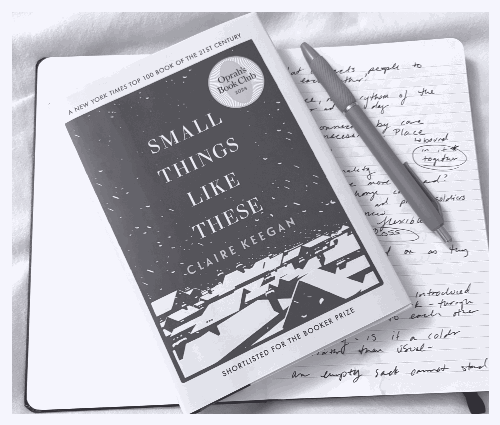
A group of News Fix readers are doing a close read of Claire Keegan's “Small Things Like These” through the theme of empathy. We're getting together weekly to discuss what we noticed and share our reflections. Revisit our conversation, catch up on a missed chapter, or just follow along with us.
Chapter one recap
It is November. We are told the story is set in a place called New Ross, and that this is a town with “shop-keepers and tradesmen, men and women in the post office and the dole queue, the mart, the coffee shop and the supermarket, the bingo hall, the pubs, and the chipper…” From context clues we glean the story is set somewhere English-speaking and British or British-adjacent*.
The weather is a main character of this four-page chapter. We hear how the cold feels and what the people of New Ross do to try to endure. We are introduced to Bill Furlong, a coal and timber merchant. He and his workers break up coal and wood and turf to sell. They work in the yard and discuss the lorry that may need new tires. When the Angelus bell rings the men wash up and go to lunch at Kehoe's, as they do every workday. The chapter is a very lean four pages.
Our discussion
We began our discussion with three questions: What does this chapter have to say about change, and what's the role of work? What seems to connect the characters to each other?
Work takes center stage in our reading. Characters are introduced to us through their work. Even the children are not exempt; going to school is presented as work. Some of us read this as bleak, and others as a more hopeful and gentle solidarity. The townspeople we are introduced to, few by name, are connected to each other by their work and by place. One of us noted that the characters are made clear through their relationships with each other and through the way that they work in service to each other.
Rhythm made a frequent appearance in our conversation. From the rhythm of the workday and the seasons that connects characters to the rhythm of Keegan's language that quickly brings us into the world of the story. This rhythm was broken for one of our readers when they found Keegan stopped panning around the place and focused in on Furlong and his choice to drive the delivery truck while his workers shovel coal and “split the loads of felled trees.” One of us felt Furlong's power and difference was made clear in that moment.
As we focused in on how we related to the theme of empathy through the chapter many of us found we didn't have fixed definitions of how we define empathy. Some of us do, and one of us defined it simply as “connection.”
We spoke about the difference between the discipline of cognitive empathy, which can be learned, and purely emotional empathy, which is less voluntary. One of us remarked that taking “the perspective of another person's internal state” may come more easily to some of us than others, but we would all benefit from realizing we can learn these skills.
A brief excerpt from the Proclamation of the Irish Republic appears on the page before the chapter begins. It says, in part,
“The Republic guarantees religious and civil liberty, equal rights, and equal opportunities to all its citizens, and declares its resolve to pursue the happiness and prosperity of the whole nation and of all its parts, cherishing all of the children of the nation equally.”
The last sentence in particular brings up the idea of how our duties to each other interact with whatever empathetic or emotional connection we may feel toward each other. Does a lack of empathy change our duty to one another? One of us brought up how the law often tries and fails to dictate empathy to structure social bonds.
We spoke about the difference between the discipline of cognitive empathy, which can be learned, and purely emotional empathy, which is less voluntary. One of us remarked that taking “the perspective of another person's internal state” may come more easily to some of us than others, but we would all benefit from realizing we can learn these skills.
A few questions we'll return to
Not an exhaustive list by any means. We'll continue to try to define empathy for ourselves and think about it as both a practice and a feeling. Some of us are interested in teasing out the difference in their feelings of sympathy and empathy and how both of these emotions relate to action. Others wonder what we are trying to activate empathy for, exactly? How does it relate to questions of citizenship and social obligation?
We'll see whether our view of a deeply connected town continues and if we might see more connections as readers than the characters themselves. A question about art we are left with is if a well-honed sense of empathy is a prerequisite to being a good writer?
On to chapter 2! Reading even four pages this way has been an exercise and a joy. Thank you.
*Correction! A previous version of this post said context clues point to this happening somewhere in the UK. We know the book is set in Ireland, just not from this chapter. A friend of mine whose dad immigrated from Ireland reminded me that Ireland is not in the UK. Shame on me.