
Close read book club: chapter 3
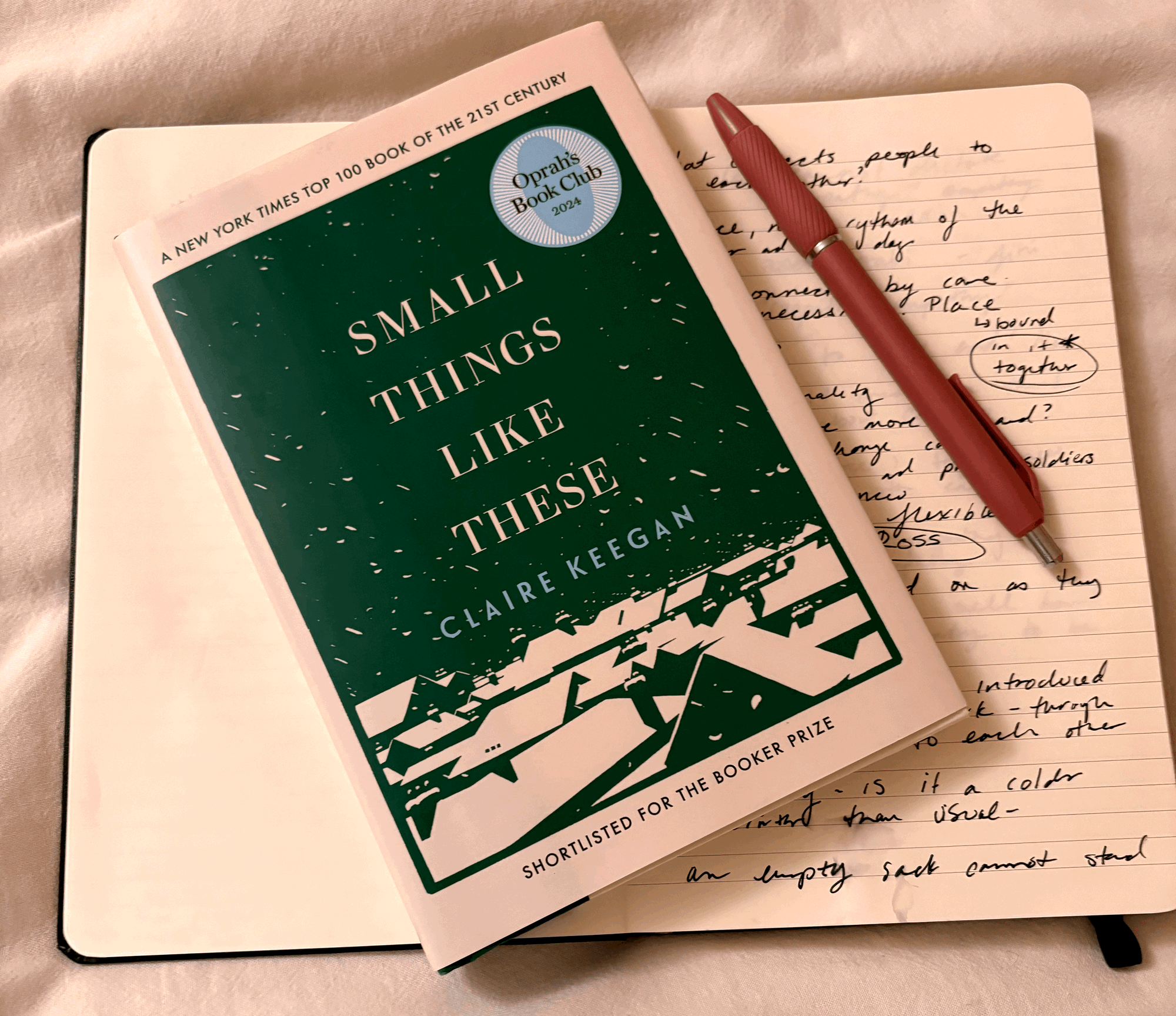
A group of News Fix readers are doing a close read of Claire Keegan's “Small Things Like These” through the theme of empathy. We're getting together weekly to discuss what we noticed and share our reflections. Revisit our conversation, catch up on a missed chapter, or just follow along with us.
Chapter three recap
The chapter opens as the town is getting ready to light the communal Christmas tree on a Sunday night.
The entire Furlong family and most of the town gather in the coal to listen to carols and watch the lighting. Oldest daughter Joan Furlong is singing in the choir. Youngest daughter Loretta is afraid of the Santa Claus at the celebration, and Bill does not push her to join the other kids, nor does he make her feel shame about her fear.
Back at home, Bill thinks back to his childhood as Eileen supervises the preparation of their annual Christmas cake. She then gets straight to the chores it takes to run a household, including, for some reason, ironing pillowcases. The girls write letters to Santa with the help of Eileen and Bill.
Bill and Eileen sit together and wait for the cake to finish baking in the anthracite-powered stove after the girls go to bed. They talk together, plan for Christmas, doze, and think until the cake comes out of the oven at 3:00 in the morning.
Our discussion
Our access to Bill's life and thoughts increases in this chapter, and with it our identification with Bill as the moral center of our story. Interestingly, he is not the moral center of his family. It is Eileen that helps the girls decide if they are asking Santa for too much. Bill is consulted on matters of spelling.
Bill seems, it was suggested, going through a midlife crisis. He wants nothing more than time to think and reflect, but having this time on a Sunday evening makes him anxious.
In our last discussion we decided to add a question to our inquiry we felt was closely bound up with ideas about empathy. We asked, “What does this chapter have to say about duty?”
We keep exploring the idea of whether depending on feeling empathy to move us to care gives us an excuse to ignore our duty of care to others, particularly those we don't easily identify with.
In this chapter we see attention as care. The Furlong household is full of dutiful attention, but it is presented as care and seems to be felt as care by our central family. Bill's ruminations about his childhood and his children also revolve around care and its absence or presence in his life. We talked about how difficult it can be to strike the right balance between duty and attention, but that when we do, we get care.
Empathy does not seem in short supply in this chapter, nor is it hard-fought. The Furlong family identify with each other routinely and easily. But our discussion was most productive when we started to wonder about the directionality of empathy. We often talk about it as an emotion that extends outward to others. We struggled to think of descriptions of what it feels like to be on the receiving end of empathy. Does the object of our empathy need to feel it? If not, is empathy a self-serving emotion, or does it really benefit others and the greater good?
We talked about how empathy seems to be a highly prized emotion and wondered if that has been true throughout history. Or do we talk so much about empathy because so many of us are lonely and disconnected, and perhaps empathy feels scarce?
Unresolved questions
We appreciated how clear it is that Keegan chooses each word carefully. Every choice feels deliberate, which keeps us puzzling over why certain details. Is the tree lighting scene a commentary on modernity coming to Ireland through electricity, as Niall Williams explores in This is Happiness?
And what are we to make of Eileen presenting Bill with such varied news from the town: a marriage, a terminal cancer diagnosis, the birth of triplets, and a circus as all similarly situated events? Also, more Enid Blyton! What does it mean!?
Some foreshadowing
We couldn't miss the line, “while the nuns walked around, supervising and talking to some of the more well-off parents,” in the text. We continue to have questions about why certain religious allusions appear where they do in this book. But this one is harsh and presages broader corruption to come.