
News Fix # 41: money isn't everything

I'm back with your weekly news fix, and I'm happy we're in this together. If you're new here, welcome! Get in touch anytime; I can't wait to hear from you.
Yesterday I had a wonderful conversation with Elizabeth Hansen Shapiro about her new report. We had a great back-and-forth about the idea of efficient scale, whether innovation is rational or irrational, civic information, ecosystem-level change, and if it's too much to expect honesty between funders and grantees.
We spoke for longer than expected (an hour!) so I'll need to cut a lot. To give her a chance to make sure my edits don't erase any important context, I'll release that interview next week.
Hansen Shapiro used more than 500 grant applications as data for her report. Each applicant identified one challenge they would use extra grant money to address. In reading the report and preparing for our conversation, I kept coming back to how difficult it can be to discern which problems are worth solving and which are distractions. That discernment gets harder when there are more challenges than we can meaningfully address.
For my entire career in news thus far, I've put most questions about how news gets paid for in my “distraction” column. I am starting to change my thinking around this and will explain why next week. But first, here's what I think these questions about business and money more generally miss.
A rational case for ignoring business questions
With any business model, there's a risk of the tail wagging the dog. Most of us do not currently have the news we want or need. Instead, we're supplied the news our current economic market will pay for. And our current economic market is absolutely bananas. The top 1% of households in America own more of the country's wealth now, about 32 cents of every dollar, than at anytime since 1989, when the Federal Reserve started measuring this. That inequality means market failures abound in every area, even crucial ones like housing, education, and food.
This economy stacks the deck against finding a real business solution for supporting the kind of news that can fulfill its essential functions and grease the wheels of democracy enough to make productive civic work across differences possible. Instead, Fox News is, by far, the country's most profitable news brand.
News can be bad at its individual and social function and still make good money. Or good at these functions and not make money. We know these contradictions to be true, but we still allow the conversations about utility, quality, and sustainability to get jumbled. A more sustainable news organization in this market is not necessarily a more valuable one.
Invite a friend into this conversation with us! Forward this along or share the site so they can find something they connect with or want to talk about.
I want answers to questions about how news can have value and efficacy, not just sustainability. How do we know what kind of news and information we need at both an individual and societal level, how do we prioritize among all these needs, and how do we make sure our work meets these needs? If we can answer these questions, we might get closer to gaining a broader audience. If we can reach a larger audience with a higher-value product, we have a better functioning society, and questions about reader revenue get easier to answer as a spillover effect. This is the sequence I would prefer.
Nonprofit status can make it possible for news organizations to innovate around making news more valuable. It makes sense to take that grace and not think too much about the business beyond shoring up revenue and limiting losses for the short or medium term. There is only so much newsrooms can do after all.
A less rational case for not worrying too much about the money
Sometimes the way information works, makes us feel, and changes how we act doesn't make any sense or money. But it matters.
I've written a little about my favorite bakery in our new neighborhood. The whole operation doesn't really make sense. It shares space with a lumberyard. I'm not kidding. It's only open twice a week, and for just a few hours on those two days. The bread is incredible. The pastry is mouthwatering. I understand the hype around tomato pie. Lines snake through the lumberyard, always. Does the business seem easy or conventional? It does not. But it does seem to be thriving somehow. In its own way, it does. You get the sense the bakers love what they do.
My youngest daughter is a baker. She's good, but her attempts to grow several sourdough starters over several months wouldn't take (smelly and gross). She is shy, but finally got the nerve up to ask the bakery if she could buy some of their starter. They gave it to her for free and were happy to do so. She baked them a treat in return and rolls at Christmas.
The bakery has two information channels. An email on Wednesdays has the upcoming week's menu. There is a small newsletter, printed on just one side of a 4×6 piece of newsprint, included in each bag of bread. My daughter reads both religiously. She would forward the emails each week, like she was my grandmother, until I signed up on my own. During the winter, as starvation and genocide in Gaza continued, those newsletters got darker. There were no more updates from the suggestion box. It was poems. Sad poems. The weekly emails announced fundraisers for Gaza. Our bakers seemed to feel a responsibility to connect us to the larger world even through their small informational enterprise. I started to see these emails as more than just menus.
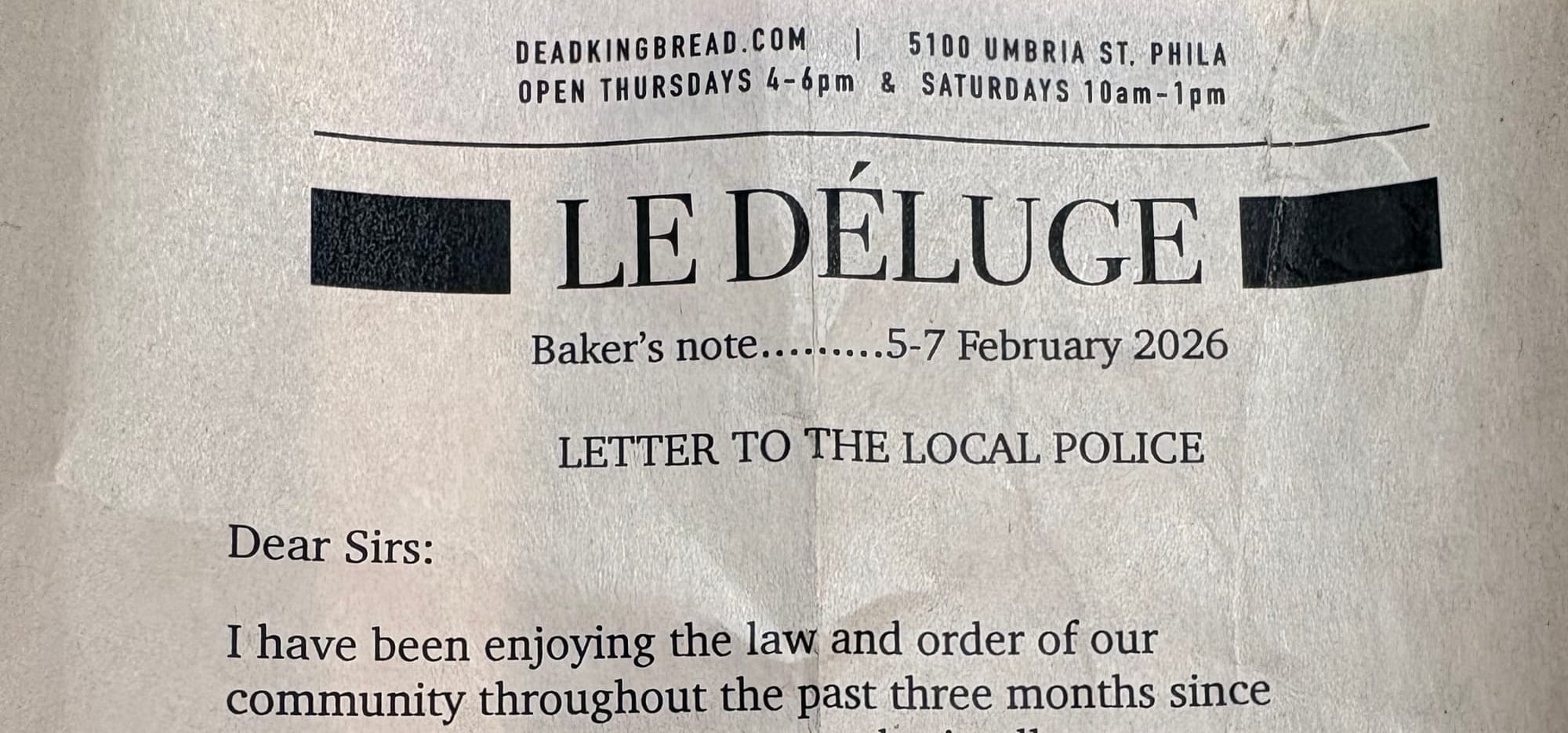
When ICE agents occupied Minneapolis and then killed Renee Good and Alex Preti, our bakers were at loose ends. In the weekly email, they said they didn't really know how to address the cruetly of our government and then just move to the menu. They said it felt exhausting and outside their lane, but also “discouraging to feel like public people are ignoring the Horrors, which we are not.”
They asked for advice and feedback. I really heard that and wrote back. I said how much I appreciated them. I said I saw their attention to injustice not as grandstanding but as a sincere expression of care, in keeping with their clear desire to provide something more than just a consumption good. It was the same, but different, as was their willingness to give away their starter to a kid. I told him I was glad my daughter saw what it looks like for it to be everyone's responsibility to grapple with what is right and wrong. I told them that my neighbor welcomed us to the block with a loaf of their bread. After going to the bakery, I knew he chose that bread not just because it's good but because it said community to him.
I haven't been back to the bakery in a few weeks because of my teaching schedule and kids sports. And you know, it's only open two days a week! But I went on Saturday. One of the bakers stopped me on my way out. She told me they have my email taped on the wall. I felt like I could cry.
Words, transmissions, caring, and connection. Sometimes it is just magic. It can fill a need we know we have, and we're grateful. When it fills a need for connection we didn't know was there, we are also transformed. Information is a mess of a business but a hell of a gift.
Until next week, take care.