
News Fix #57: I'll blow your house down
I'm back with your weekly news fix, and I'm happy we're in this together. If you're new here, welcome! Get in touch anytime; I'd love to hear from you.
For the last few months I've been trying to better navigate the tension between our duty in news to create an accurate record of events and document the world as it is; a fundamentally reflective duty, with a more generative responsibility I think we have to help build societies that work better for more people.
This is not a small tension. If we expect journalists to get off the proverbial sidelines but not become activists, propaganda pushers, or hacks we need world building frameworks more of us can agree on; clearer ideas of the public interest and of civic health, an understanding of what responding to information needs really looks like, a civil rights framework as a backstop for community values. I spent the last few months researching these ideas, writing about them, funding small experiments here in Philly, vibe-coding tools, helping plan a News Futures working group to identify more civic information actors outside of news (if you're interested in joining just let me know).
It's all felt productive. But my pattern-philic, coherency obsessed brain wasn't quite satisfied with the central problem I was organizing all this work around.
Until this past weekend when I was reading up on “Google Zero” and it finally clicked. The tension I identified earlier this summer-between work that reflects and work that seeks to improve, does matter and does hold news back. But these are symptoms of the economic choices and values that dominate our news and information systems.
The central tension in news and information is our desire to center capital as the organizing principle rather than centering community, which the survival of democratic information systems and functional societies demands.
Google Zero (if, like me, you experienced some of these changes from inside a newsroom but missed the more macro perspective) is a term of art. It describes the impact of Google changing moving away from putting search at the center of its business model and realigning its economic incentives.
Google seems worried that continuing to rely on advertising tied to search-trusting people will click the links-will become less financially stable. Instead, the company is banking on ads tied to content on its own platform (YouTube) and within a Gemini powered AI agent experience.
Both of these moves disincentive Google connecting users to the non-Google owned or controlled open web.
Publishers have already seen their traffic from search decline accordingly and some are refusing to allow Google to continue to index their sites for free. Consumers might now be spending only a quarter of their time on the open web, and 75% with AI agents, including Gemini, or on social. Last week, the EU found and fined Google 890 million euros for answering searches by prioritizing information from services it owns, like Google shopping or Google Flights, even when that information linked customers to more expensive options.
If the economic incentives of search shift profoundly enough, traffic to information sites from Google could, theoretically, drop to nothing, or Google Zero. The freak-out is about the specific economics of search collapsing, but not entirely. It is also a broader concern that Google is squeezing the stem of the funnel we believed we became accustomed to traveling through easily on our way to a robust supply of human centered, diverse and accessible information.
Value system by default
Google is one of the largest and most profitable companies in the world (it's number three or four, depending on the list). The idea that the quality, variety, and affordability of something as fundamental as digital information is secondary to maintaining that level of profitability is feasible and unacceptable. It is not, however, inevitable.
I have friends and colleagues who've already had this deeper understanding and said the very words, “we need to center community over capital.” Sorry Lindsay! I agreed without fully reckoning with that idea.
Readings I have recommended in class or here, from Cory Doctorow on enshitification to Francesco Marconi's Who Will Monetize Truth do confront ideas of market failure in news and information. But they are more reflective than generative. We may understand that economic concerns define the kind of information we get and how it is produced and provided. But how do we break out of this dynamic?
The house we can build
In middle school I had a summer babysitting job taking care of two young children for a few afternoons a week. Raised on a steady diet of The Babysitters Club books, it was a point of pride that I rarely let kids I took care of watch TV. But the parents in this family were getting a divorce and the kids needed comfort in spades. After a few weeks we started watch a short VHS(!) video after lunch. Unfortunately, these kids had very few short videos and a hauntingly strange compilation of Disney cartoons from the 1930s and 40s was on heavy rotation. It included a disturbingly cruel musical version of the Three Little Pigs. This memory emerged from my subconscious because whatever else that thing is, it is also a story about preparing for the future.
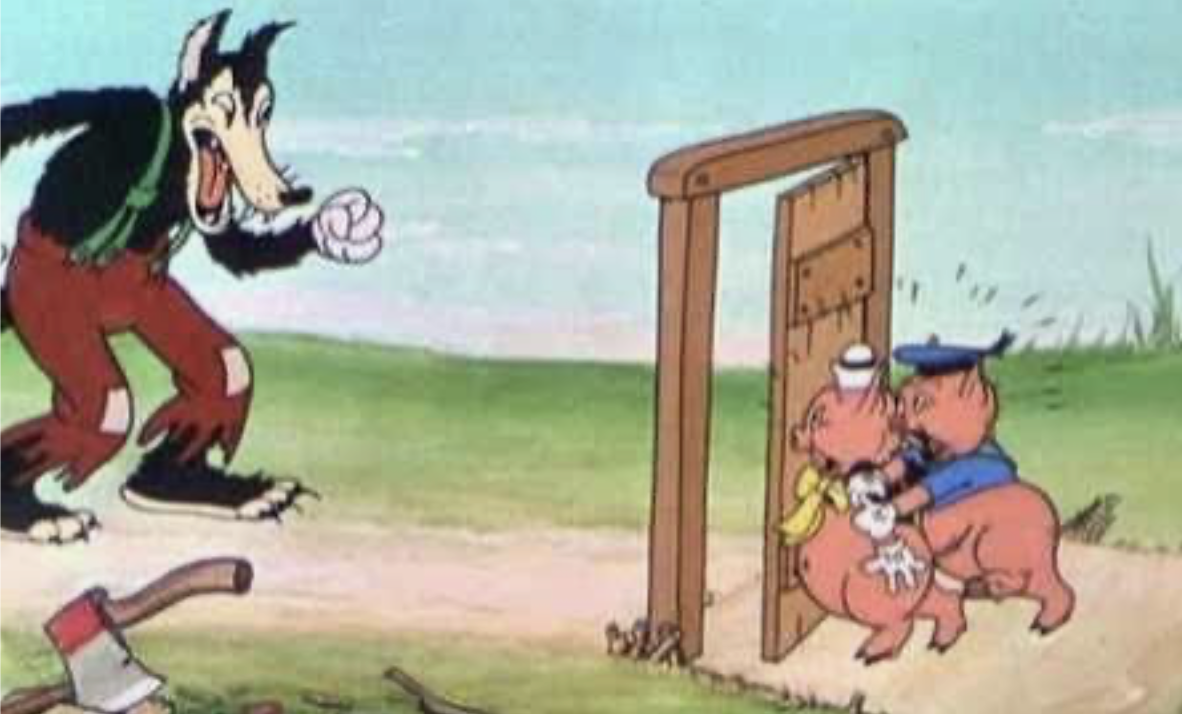
News providers have been building houses out of straw and sticks for years and years. The first two little pigs were not driven to their construction materials of choice by laziness or necessity in this version of the story. “Who's Afraid of the Big Bad Wolf?” is the chorus of the song that repeats throughout the cartoon, reminding us these pigs ended up ill-equipped because of a false sense of security. We can understand and can name threats we face; AI, platform dominance, Google Zero, etc. But do we really believe the level of threat? We don't want to really believe that the same system that allowed the news to flourish for many years could blow the whole house down. It can, of course.
If we want to rebuild a system in decline into something more meaningful for more people it will take concentrated and disciplined effort. We need a house of bricks. That will require capital (we could in fact, demand it from the AI companies monetizing the entirety of human knowledge, a collective resource if ever there was one). It will require engaging deeply with questions about when sustainability matters and how to make that possible.
We don't, however, have to put capital concerns at the center of everything we imagine. Centering capital can be generative and creative. There are products and advances arise every day from a desire to break into a market, to scale, to create commodified value for investment. Am I grateful for lightbulbs, coffee pots, Levi's jeans, birth control? I am!
But to center capital in a social necessity like high-quality news and information is to set the floor of what “works” much too low. Private equity ownership of news brands works. Fox News and MS NOW work, public media that doesn't serve and isn't supported by a broad swath of the public works. All of these things are financially feasible. They are also, fundamentally, strategies to extract value before the structures collapse. They are not about creating longer term value. We deserve better. We can build a house of bricks.
I might take two weeks off to accommodate for some weekend work and travel I have coming up. Not sure yet. In the meantime, tell me I'm wrong, ask me about our News Futures working group, recommend some more reading for me. Avoid watching the Three Little Pigs unless you want nightmares, and take care of yourself.