
Close read book club chapter 2
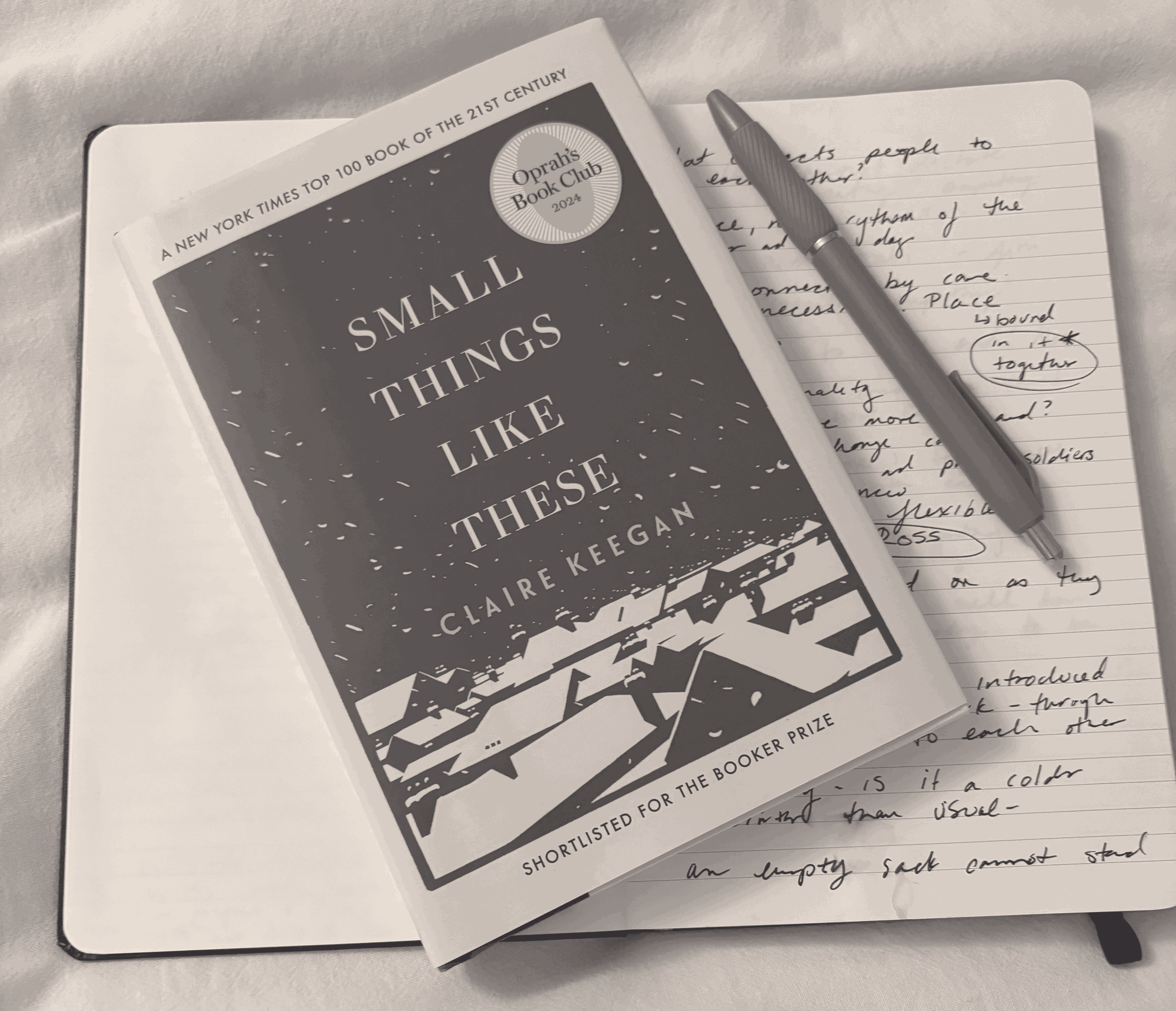
A group of News Fix readers are doing a close read of Claire Keegan's “Small Things Like These” through the theme of empathy. We're getting together weekly to discuss what we noticed and share our reflections. Revisit our conversation, catch up on a missed chapter, or just follow along with us.
Chapter two recap
We begin where Bill Furlong begins, at his birth. Furlong's mother, unnamed, was 16 when she was abandoned by her family because she was pregnant. Her employer, the Protestant widow Mrs. Wilson, was less judgmental. Bill grew up with his mother in Mrs. Wilson's now interfaith household until his mother died when Bill was 12. These tragedies are presented with little elaboration. Mrs. Wilson continued to care for Bill, who after school started to work in the coal yard he now owns due to his “good head for business” and ability to stay on the right side of people. Bill is married to Eileen, and together they have five beloved daughters. We learn that New Ross is in Ireland, and our story is set in 1985. Bill is now 39 years old. The country is going through a serious economic crisis, and many in New Ross are having trouble meeting their basic needs. The economic precarity in the land weighs on Bill so much that he is beginning to lose sleep.
Our discussion
This chapter feels quite distinct from the one before. Bill's prosperity in chapter one is refracted here into a picture of hard economic times across the country. The interconnected community of New Ross from chapter one is presented in more complexity. We see conflict now, some cruelty, and a scarcity mindset. Eileen believes “somebody has to draw the short stick.”
As readers, we have plenty of opportunities for empathy: the cows left unmilked, the dogs and cats foraging for food, the cold families who can't pay their utility bills, and two hungry children doing what little they can to care for their needs. There is plenty of room for judgement too. There is the casual cruelty of Bill's mother's family abandonment of a pregnant teenager. Later his schoolmates also judge and bully him for the circumstances of his birth.
Two responses to suffering are contrasted in the chapter. Mrs. Wilson's approach is an almost pragmatic decency. She provides a home for Furlong's mother and for him across their religious difference without much fuss at all. We learn she even gives Furlong a few thousand pounds to help him start his household with Eileen. Despite how consequential these decisions are, as readers we barely see empathy at play. The contrast with this attitude is a short scene where Bill tells Eileen about driving past a young boy they know walking along the road collecting sticks to burn for warmth. Bill gives him a bit of money and a ride. Eileen seems almost indifferent to the boy's suffering, focusing instead on the child's fathers' alcoholism as the cause of this suffering.
We had plenty of reads on this scene. It looks like a lack of empathy by Eileen and a surplus by Bill. Perhaps she is worried; perhaps there is something in her yet-to-be-revealed backstory that explains it. A few readers felt that Bill's understanding of his vulnerability as a child drives his behavior. Another read was that Eileen's emotions get in the way of empathy, rather than moving it along. Bill seems more pragmatic about suffering here, recognizing without analyzing and moving to compassionate action. We agreed it is difficult to know what really drives our emotional responses and how we get to both empathy and action.
The strain of decency carried by Mrs. Wilson and then Bill Furlong through the chapter is up against a lot of fear of change and real suffering. The long tail of trauma is snaking its way through these pages. Change appears on the horizon, and we worry about New Ross. Some beautiful lines and sentiments unfolded in chapter two, but we are left feeling some foreboding.
Gems from the outside world
One of us found it strange that such specific, real-world details were dropped into the text that otherwise feels almost like a fable. There is an art contest sponsored by Texaco, for example. One minor character drives a Jeep. A Furlong daughter is reading books by Enid Blyton. I usually keep it anonymous in these recaps, but Kate googled these details after our group and sent some nuggets my way. Blyton, who I had never heard of, was a staple of British children's literature. She is criticized for filling her books with a brand of social conservatism rife with sexism, racism, and xenophobia. There's a BBC dramatization of her life starring Helena Bonham Carter, who is a Johnny Depp and JK Rowling apologist herself. I won't be able to stay away! The Texaco art contest is still going strong in the real world as well as in New Ross. I haven't yet found a blue chicken in the available archive, alas.
Stray thoughts
After last week's discussion, one of our readers looked up the antonym of empathy, which is apathy. Does that ring true to us?
Last week one of our readers thought Bill Furlong being the boss of the yard set him apart and was one of the few examples in Chapter One of a power differential. The revelation of his job was such a stark break in the rhythm of the chapter it demanded notice. Does the new information about how long Furlong has been at the yard and what qualities have gotten him there change our reading?